
Bond Pricing
- #financial-management
- #bond
- #bond-pricing
- #yield-to-maturity
- #zero-coupon-bond
Bond Pricing
Part of: Financial Management Lesson 7 — Financial Management & Finance Key concepts: Bond, Coupon, Face Value, Yield to Maturity, Zero-Coupon Bond
What a bond is
A bond is a loan to the issuer. It has three features:
The three things on a bond
- Face value (par) — the principal repaid at maturity (e.g. $100 or $1000).
- Coupon rate — the periodic interest, quoted on the face value (e.g. 5% → $5/yr on $100 face).
- Maturity — when the face value is returned.
A bond's price is just the PV of its cash flows — the coupons (an annuity) plus the face value (a single flow) — discounted at the market yield for bonds of similar risk:
In Excel: -PV(r, n, C, FV).
The price–yield relationship
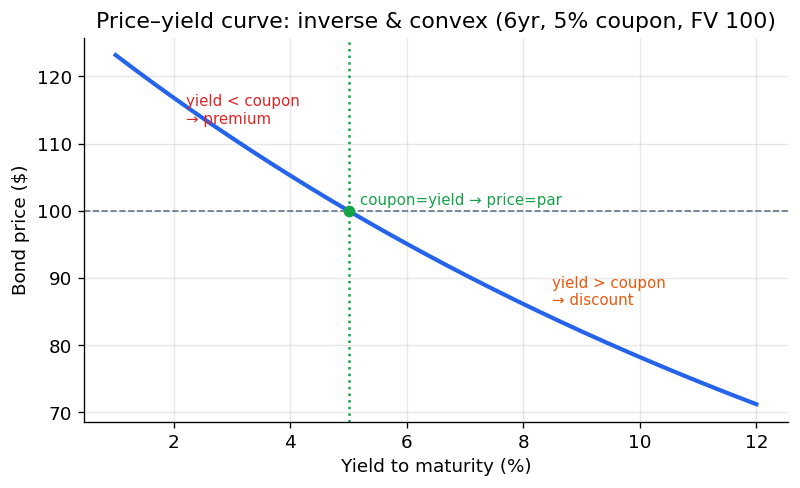
Price and yield move in opposite directionsWhen the market yield rises, the fixed coupons are discounted harder → the price falls, and vice versa. The relationship is also convex (curved), not linear.
Premium, par, discount
Condition Price Name coupon rate yield premium bond coupon rate yield par bond coupon rate yield discount bond Intuition: if the bond pays more than the market demands, buyers bid the price above par until the yield falls to the market rate.
Straight bond — 6yr, 5% coupon, FV 100Coupons of $5/yr plus $100 at year 6. At market yield 5.5%: — a discount (coupon 5% < yield 5.5%). ✓
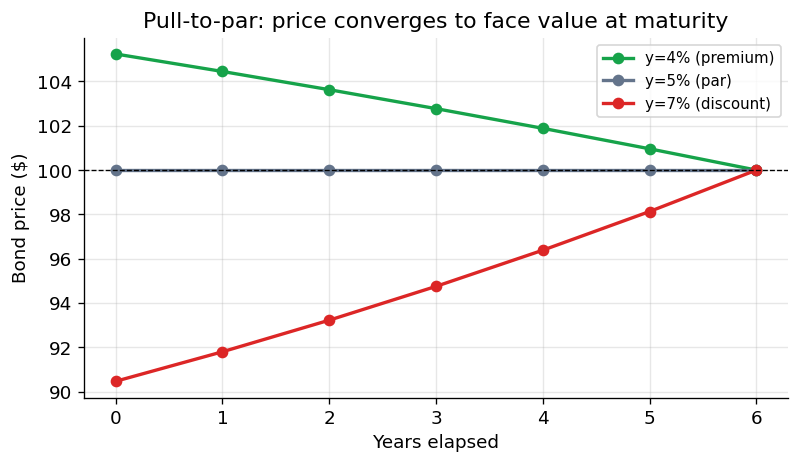
As a bond ages toward maturity its price is pulled to par regardless of where it started:
Pricing between coupon dates: before vs after
"After the coupon" vs "before the coupon"
- Price after a coupon = PV of the remaining (future) coupons + face. This is the standard
-PV.- Price before a coupon = price after the coupon about to be paid (the seller is entitled to that imminent coupon).
The 5% bond at , yield now 4%After the year-2 coupon: . Before it (still owed the $5 coupon): .
Special bond structures
Partial-redemption bond
Face value repaid in instalments, so the coupon (charged on the outstanding face) steps down after each redemption.
$1000 face, 8% coupon, $500 repaid at yr 2, rest at yr 5Coupons: $80/yr while $1000 outstanding (yrs 1–2), then $40/yr on the remaining $500 (yrs 3–5). Price at 7% yield .
Semi-annual & CPI-linked bond
Coupons paid twice a year use half the stated coupon on each date ( of face). If the bond is CPI-linked, discount at the real semi-annual rate, then convert the resulting real value back to a nominal price using actual inflation.
$100 face, 6% semi-annual coupon, 5yr, nominal 7%, expected inflation 1.8%Real annual rate ; real semi-annual . Price . (See Lesson_04-Inflation, Real Rates & Expected Inflation for the real/nominal conversion.)
Zero-coupon bond
No coupons at all — just one payment of face value at maturity. Pure discounting:
4-yr zero, , payment. A zero always trades at a discount (no coupons to lift it).
Comparison table
| Bond type | Cash-flow pattern | Pricing approach |
|---|---|---|
| Straight | level coupon + face at end | -PV(r,n,C,FV) |
| Partial redemption | stepped coupon, face in instalments | NPV of bespoke CFs |
| Semi-annual | coupon/2 each half-year, periods | -PV(r_semi, 2n, C/2, FV) |
| CPI-linked | real coupons; discount at real rate | real PV → convert to nominal via inflation |
| Zero-coupon | single FV at maturity |
Summary
Key takeaways
- A bond price is the PV of coupons (annuity) + face value (single flow);
-PV(r,n,C,FV).- Price and yield move inversely and convexly; coupon vs yield determines premium/par/discount.
- "Before-coupon" price = "after-coupon" price + the imminent coupon.
- Semi-annual coupons use coupon/2 over periods; CPI-linked bonds discount real cash flows at the real rate, then convert to nominal.
- A zero-coupon bond is pure discounting of the face value and always trades at a discount.
Related Notes
- Lesson_01-Time Value of Money — annuity + single-flow PV that build the bond price
- Lesson_04-Inflation, Real Rates & Expected Inflation — real/nominal conversion for CPI-linked bonds
- Lesson_05-The Four Loan Types — a bond is a loan to the issuer
- HW_08-Bond Pricing — problem set: above/below par, semi-annual, solving for the coupon
- Financial Management — subject hub