
Capital Budgeting & Free Cash Flow
- #financial-management
- #free-cash-flow
- #capital-budgeting
- #depreciation
- #working-capital
Capital Budgeting & Free Cash Flow
Part of: Financial Management Lesson 6 — Financial Management & Finance Key concepts: Free Cash Flow, Capital Budgeting, Depreciation, Working Capital, Opportunity Cost
The goal: get the right into the NPV
NPV is only as good as the cash flows you feed it. This lesson is the discipline of building project Free Cash Flow correctly. The headline mantra: Cash is King — we discount cash, not accounting profit.
The FCF build (top to bottom)
From sales to free cash flowSales − Cost of goods sold, SG&A, Marketing, R&D ± Synergies / Cannibalization = EBITDA − Depreciation & Amortization = EBIT (operating profit) − Tax (on EBIT) = NOPAT + Add back Depreciation (non-cash) − CAPEX − Increase in Working Capital + Salvage proceeds (after capital-gains tax) = Free Cash Flow
The five principles
1. Cash is King
Discount cash, not profit. Accounting items that aren't cash (like depreciation) must be handled carefully — see principle 4.
2. Only marginal effects
What "marginal" rules in and out
- Ignore sunk costs — money already spent and unrecoverable is irrelevant to the decision. (R&D spent before the go/no-go is sunk.)
- Inspect overhead allocations — only include extra overhead the project actually causes (new hires, overtime, electricity), not an arbitrary share of head-office cost.
- Do NOT ignore synergies / cannibalization — a new conditioner may boost shampoo sales (synergy, +) but eat into other conditioners (cannibalization, −). Both are real marginal effects.
3. Opportunity cost
Using a resource you already own isn't freeThe cost of deploying a resource = its best alternative use. Building on land you own still "costs" the rent or sale price you forgo. Always charge the project the opportunity cost.
4. Separate financing from investment
Ignore interest on loansEvaluate the project as if fully equity-financed — exclude interest and loan repayments from the cash flows. The cost of debt is already captured in the discount rate (the cost of capital). Mixing financing into the cash flows double-counts it.
5. Depreciation is not cash — but don't ignore it
Depreciation is a non-cash expense, yet it matters because it is tax-deductible. The trick is the depreciation tax shield: you subtract depreciation to compute taxable EBIT, then add it back after tax because no cash actually left.
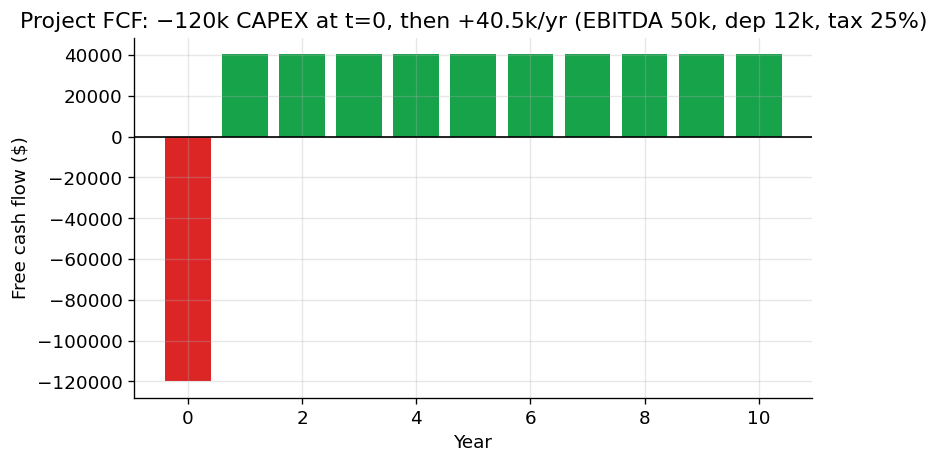
Tax shield in actionCAPEX $120k, salvage 0, 10-yr life → depreciation /yr. With EBITDA and 25% tax: EBIT ; tax ; NOPAT ; add back depreciation → FCF /yr. The depreciation saved of tax even though it isn't a cash cost.
Tax with losses, working capital & terminal value
Tax when profit is negativeIn this course we assume symmetric tax: positive profit is taxed; a loss generates an immediate tax saving (negative tax). So a year with EBIT at 25% gives of tax benefit.
Working capitalAn increase in net working capital (inventory, receivables) ties up cash → a negative cash flow when it rises, recovered (positive) when the project winds down. Always model , and recover the cumulative WC at the end.
Terminal / salvage valueWhen the project ends and assets are sold, add the sale proceeds, less capital-gains tax (20% in the course) on any gain above book value.
Summary
Key takeaways
- (+ after-tax salvage at the end).
- Cash is king — discount cash, never accounting profit.
- Count only marginal effects: ignore sunk costs, include synergies/cannibalization and opportunity cost.
- Separate financing from investment — value as if all-equity; the discount rate carries the cost of debt.
- Depreciation isn't cash but its tax shield is — subtract it for tax, add it back after.
- Model working-capital changes and after-tax terminal value.
Related Notes
- Lesson_02-Perpetuities, NPV & IRR — the NPV these cash flows feed into
- Lesson_05-The Four Loan Types — why we strip financing out (it lives in )
- HW_07-Free Cash Flow & Project NPV — full FCF problem set with WC, opportunity cost & tax shields
- Financial Management — subject hub