
Inflation, Real Rates & Expected Inflation
- #financial-management
- #inflation
- #real-interest-rate
- #fisher-equation
- #nominal-vs-real
Inflation, Real Rates & Expected Inflation
Part of: Financial Management Lesson 4 — Financial Management & Finance Key concepts: Inflation, CPI, Nominal Rate, Real Interest Rate, Fisher Equation
Money vs purchasing power
Interest makes your bank balance grow, but inflation makes each dollar buy less. What you actually care about is purchasing power — how many apples you can buy, not how many dollars you hold. This lesson separates the two: nominal returns (dollars) from real returns (apples).
Measuring inflation with the CPIThe CPI (Consumer Price Index) tracks the price of a basket of goods. Inflation between two dates is the percentage change: e.g. rising is .
The Fisher equation — the exact relationship
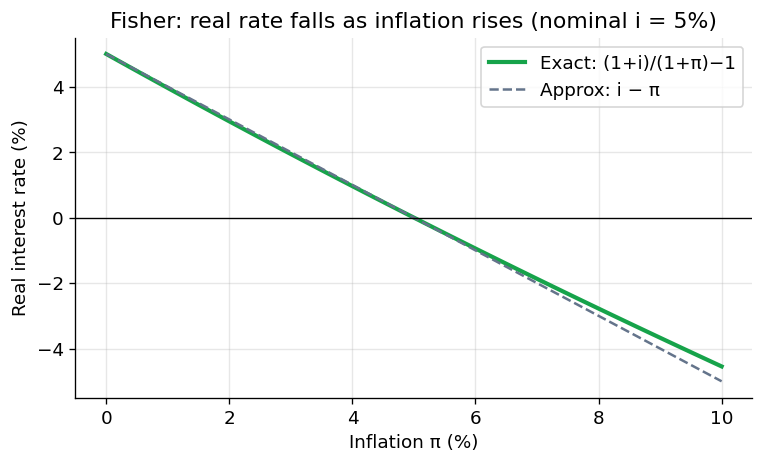
The real rate is what's left of your nominal return after inflation erodes purchasing power. Crucially it is a ratio, not a subtraction:
The apples derivation (why it's a ratio)Start with $100 and one apple costs $1 → you can buy 100 apples. After a year at you have $105; with inflation an apple now costs $1.02. Apples you can buy: . Your real return is — exactly .
The approximationFor small rates the ratio is well-approximated by simple subtraction: . The approximation overstates the real rate slightly and worsens as inflation rises — always use the exact ratio in calculations.
Nominal vs real cash flows — match them to the right rate
The golden rule of discountingDiscount nominal cash flows at the nominal rate; discount real cash flows at the real rate. Mixing them is wrong. Both give the same PV if done consistently.
A $1000 promise in 7 years, , expected
- Nominal payment (fixed $1000): .
- Inflation-adjusted (real) payment: the $1000 is in today's purchasing power, so discount at the real rate : .
The inflation-protected promise is worth more — it preserves purchasing power. Check: , the total inflation over 7 years. ✓
Adjusting a future payment for inflation
If a payment is contractually linked to inflation, scale it up by the realised price change before discounting:
| Information given | Adjusted (nominal) payment |
|---|---|
| Total inflation 20% over the period | |
| 1.5%/yr for 3 yrs then 3.45%/yr for 4 yrs | |
Expected vs actual inflation
Two distinct moments
- At decision time you discount using expected inflation (and hence the expected real rate) — it's all you know.
- Later, when actual inflation is realised, you re-price using the real value compounded by the actual inflation to convert back to nominal (dollar) terms.
Re-pricing after the factA CPI-linked bond worth 102 "apples" at , with actual inflation 2%/yr, has nominal price — convert real value to dollars using the actual cumulative inflation since issue. (Worked fully in Lesson_07-Bond Pricing, the CPI-linked bond.)
Summary
Key takeaways
- Inflation .
- Fisher (exact): ; approximation only for small rates.
- Match the cash flow to the rate: nominal↔nominal, real↔real. Both routes give the same PV.
- Inflation-protected (real) payments are worth more than fixed nominal ones because they preserve purchasing power.
- Use expected inflation to value today; use actual inflation to re-price and convert real values back to dollars later.
Related Notes
- Lesson_03-Rate Conversion, Effective Rates & EAC — the other rate-conversion toolkit
- Lesson_07-Bond Pricing — CPI-linked bonds put real/nominal pricing to work
- HW_05-Inflation & Real Annuities — retirement & tuition planning in real terms
- Financial Management — subject hub