
Perpetuities, NPV & IRR
- #financial-management
- #perpetuity
- #npv
- #irr
- #project-evaluation
Perpetuities, NPV & IRR
Part of: Financial Management Lesson 2 — Financial Management & Finance Key concepts: Perpetuity, Growing Perpetuity, Net Present Value, Internal Rate of Return, Discount Rate
Perpetuities — annuities that never end
A perpetuity pays a level every period forever. Taking the annuity formula and letting , the term , leaving a strikingly simple result:
Check, → . Summing 50 years of discounted $100 already gives ; the remaining infinite tail adds only — almost all the value of a perpetuity sits in the early payments.
Growing perpetuity (the Gordon formula)
If payments grow forever at rate :
The convergence conditionIf the sum diverges — an infinite stream growing at least as fast as it is discounted is worth infinity. The formula is only valid when the discount rate strictly exceeds the growth rate. here is the first payment (at ), not the time-0 amount.
Check, , → .
Net Present Value — the master decision rule
NPV is the value created by a project: the PV of all future cash flows minus the initial investment.
The ruleAccept if . A positive NPV means the project returns more than the cost of capital — it adds wealth today, measured in dollars.
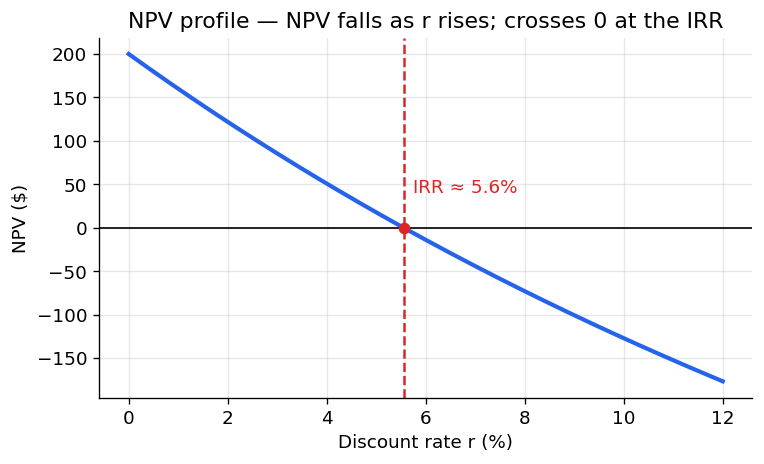
Lecture projectat gives → reject at 6%. But the NPV profile below shows it would be accepted at any rate below the IRR (≈5.55%).
Excel'sNPVquirk — off-by-one
NPV(rate, values)assumes the first value is at , not . So for a project with a time-0 outlay you must write=NPV(r, CF1:CFn) + CF0, adding the un-discounted initial flow separately. Writing=NPV(r, CF0:CFn)discounts the outlay by one period too many.
Internal Rate of Return
The IRR is the discount rate that makes — the project's own break-even return.
The ruleAccept if (the hurdle/cost of capital). Graphically, the IRR is where the NPV profile crosses zero. Excel:
IRR(values, [guess]).
Why IRR can mislead — three traps
1. IRR measures profitability, NPV measures profitA project returning 300% on $1 (IRR = 3.0) creates $3 of value; a project returning 30% on $100{,}000 creates $30{,}000. IRR ranks the first higher, but NPV — and your bank balance — prefer the second. For mutually exclusive projects, rank by NPV, not IRR.
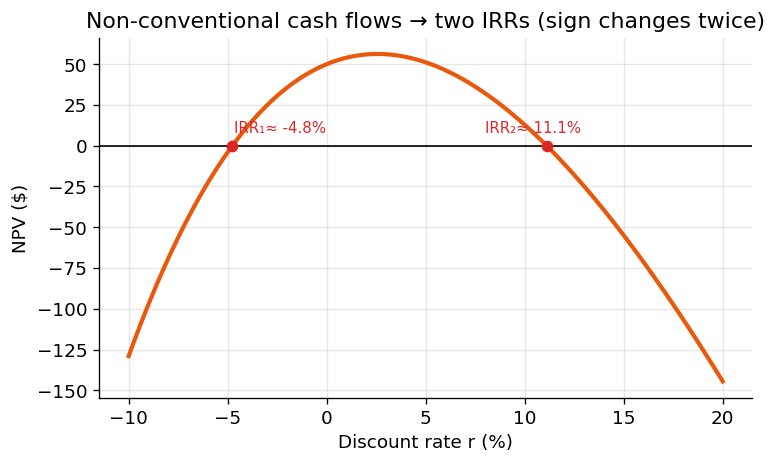
2. Multiple IRRsWhen cash flows change sign more than once (e.g. outflow → inflow → outflow), the polynomial can have several roots. The cash flow has two IRRs (≈ −4.8% and ≈ 11.1%). Excel returns whichever is nearest your
guess, so the answer is ambiguous — fall back to NPV.
3. The reinvestment assumptionIRR implicitly assumes every interim cash flow is reinvested at the IRR itself. For a high-IRR project that is unrealistic — you rarely have other projects yielding the same high rate. NPV assumes reinvestment at the cost of capital , which is the economically correct benchmark.
NPV vs IRR — when do they agree?
| Situation | NPV | IRR | Use |
|---|---|---|---|
| Single project, conventional CFs | accept if | accept if | agree |
| Mutually exclusive projects | rank by created | can mis-rank (scale/timing) | NPV |
| Non-conventional CFs (sign changes) | one clear answer | multiple/none | NPV |
| Comparing very different scales | correct | biased to small projects | NPV |
One-line verdictWhen NPV and IRR disagree, trust NPV. IRR is a useful communication tool (a percentage return) but NPV is the decision rule because it measures dollars of value added and uses the right reinvestment rate.
Summary
Key takeaways
- Perpetuity ; growing perpetuity , valid only when .
- NPV discounts every cash flow to today; accept if NPV > 0. Mind Excel's
NPVoff-by-one — add separately.- IRR is the rate where NPV = 0; accept if IRR > r.
- IRR's three traps: profitability ≠ profit, multiple IRRs with sign changes, and an unrealistic reinvestment assumption.
- When the two rules conflict, NPV wins.
Related Notes
- Lesson_01-Time Value of Money — annuities (the finite version of perpetuities) and the PV machinery
- Lesson_03-Rate Conversion, Effective Rates & EAC — profitability index & EAC for ranking under constraints
- Lesson_06-Capital Budgeting & Free Cash Flow — getting the that go into NPV right
- HW_02-NPV, IRR & Project Choice — problem set on NPV vs IRR ranking
- Financial Management — subject hub