
The Four Loan Types
- #financial-management
- #loan
- #amortization
- #mortgage
- #outstanding-balance
The Four Loan Types
Part of: Financial Management Lesson 5 — Financial Management & Finance Key concepts: Loan, Amortization, Outstanding Balance, Mortgage, Bullet Loan
The anatomy of every loan
Every loan payment splits into two parts: interest (the rent on the money still owed) and principal (the repayment of the debt itself). The Amortization table tracks this period by period:
The five columns of any amortization table
Column Formula Meaning Beginning balance prior debt owed at start of period Interest rent on outstanding debt Principal depends on loan type debt repaid this period Total payment the cheque you write Ending balance debt still owed Interest is always the current balance. What distinguishes the four loan types is how the principal is scheduled.
The four types differ only in which column is held constant:
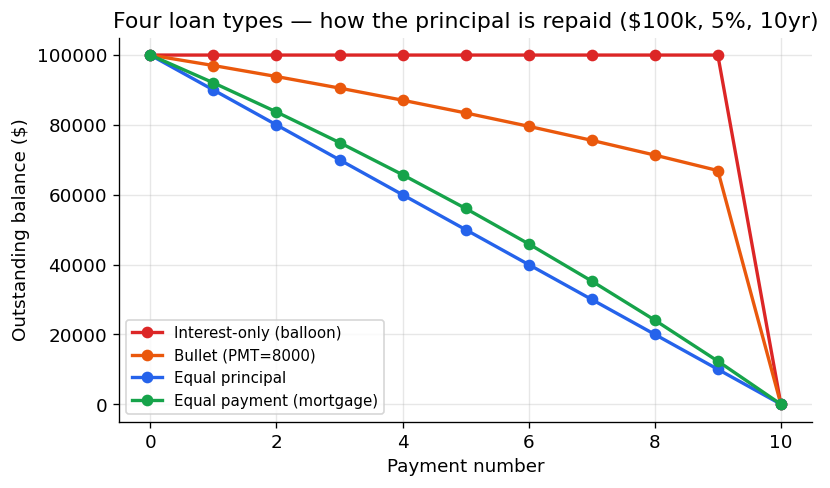
1. Interest-only loan (balloon / grace)
Every payment is interest only; the entire principal is repaid in one lump (the "balloon") at maturity.
$100k, ,Payments 1–9: interest, $0 principal. Payment 10: interest principal . The balance stays at $100k the whole time — see the flat red line above.
2. Equal-principal loan (equal amortization)
Principal repaid in equal chunks each period; interest falls as the balance shrinks, so the total payment declines over time.
$100k, ,every period. Payment 1: . Payment 10: . Balance falls in a straight line (blue line above). Outstanding balance after 6 years .
3. Equal-payment loan (the mortgage)
The total payment is constant every period. Early on most of it is interest; over time the principal portion grows — the classic mortgage amortization. The level payment is an annuity:
$100k, ,every year. Payment 1 is $5{,}000 interest + 12{,}334 principal.
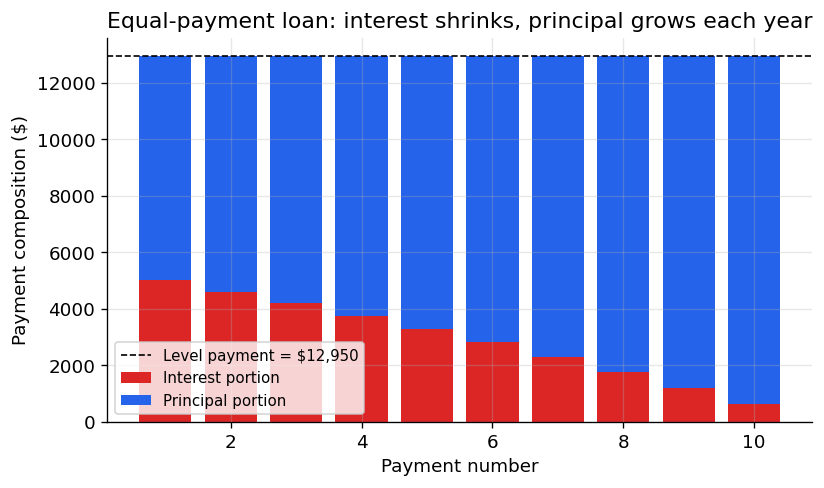
Why interest shrinks and principal growsThe payment is fixed, but interest balance and the balance keeps falling. So the interest slice shrinks each period, and since principal , the principal slice must grow to fill the constant payment.
4. Bullet loan
The borrower and bank agree a fixed payment (given, not solved) that does not fully cover amortization on a normal schedule; whatever principal remains is cleared in a final balloon. Two regimes:
PMT > interest vs PMT < interest
- (e.g. ): the payment covers interest and chips away at principal — balance falls gradually, final balloon is moderate. (Orange line above.)
- (e.g. ): the payment doesn't even cover interest, so the balance grows (negative amortization) until a large balloon at the end. Dangerous structure.
Three things you'll always be asked
A. Outstanding balance at time
The balance you still owe = PV of all remaining payments at the contract rate. For an equal-payment loan with payments left:
For non-level loans you must read it off the amortization table or NPV the remaining cash flows.
B. Early-termination fee
If you repay early when market rates have fallen, the loan is worth more to the bank than its book balance, so they charge a penalty equal to the shortfall:
Equal-payment loan, , rates dropped to 3%Book balance (at contract 5%) . Fair value (remaining payments discounted at the new 3%) . Fee . Total to walk away .
C. Splitting a single payment into principal & interest
For an equal-payment loan, Excel gives both pieces directly:
- Interest part:
IPMT(r, t, n, -L) - Principal part:
PPMT(r, t, n, -L)
7th payment of the $100k mortgageInterest ; principal ; sum . ✓
Comparison table
| Loan type | What's held constant | Total payment over time | Excel for the payment |
|---|---|---|---|
| Interest-only | principal paid = 0 until end | flat, then balloon | each period |
| Equal-principal | principal | falls | |
| Equal-payment (mortgage) | total payment | constant | PMT(r,n,-L) |
| Bullet | a given payment | constant, then balloon | given; balloon = residual |
Summary
Key takeaways
- Interest is always current balance; loan types differ only in the principal schedule.
- Equal-payment (mortgage): level payment from
PMT; interest portion shrinks, principal portion grows.- Outstanding balance = PV of remaining payments at the contract rate.
- Early-termination fee = ; it bites when rates have fallen.
- Use
IPMT/PPMTto split any equal-payment instalment into interest and principal.
Related Notes
- Lesson_01-Time Value of Money — the annuity formula behind the level mortgage payment
- Lesson_02-Perpetuities, NPV & IRR — NPV/PV used for fair value of a loan
- Lesson_07-Bond Pricing — a bond is essentially a loan to the issuer
- HW_06-Loans & Amortization — problem set on schedules, refinancing & CPI-linked loans
- Financial Management — subject hub